Artificial Intelligence has dominated boardroom conversations over the past two years. Yet, in many organizations, those discussions have largely been driven by CEOs, IT departments, and software vendors.
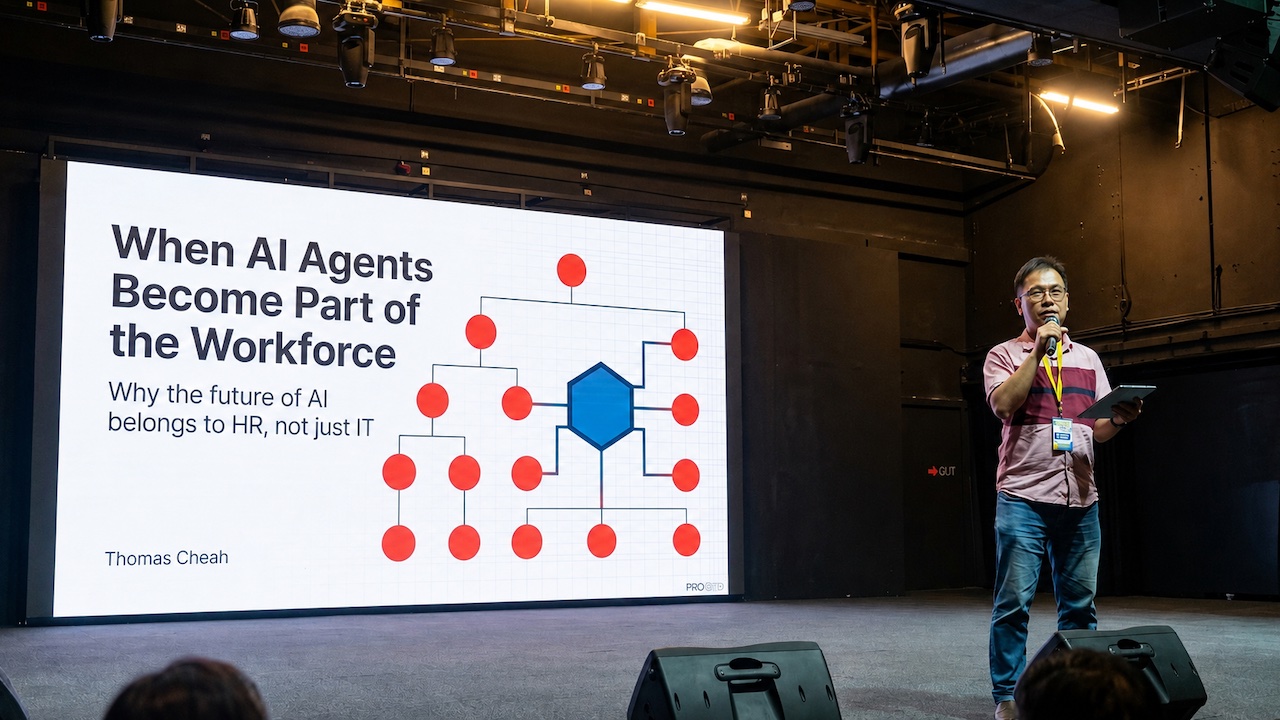
At the recently concluded HR Carnival 2026, organized by Kakitangan.com, our Principal Fractional CTO & AI Transformation Advisor, Mr. Thomas Cheah, challenged this narrative with a thought-provoking message:
The biggest AI challenge is no longer a technology challenge—it is a workforce challenge. And workforce challenges have always belonged to HR.
Speaking to an audience of HR professionals, business owners, and people leaders, Thomas explored why HR will play a pivotal role as AI Agents become part of the workforce.
AI Is No Longer Just Software
Traditional software has always been passive. It waits for instructions, processes data, and supports employees in completing their work.
AI Agents represent a fundamental shift.
Rather than simply supporting work, they can now interpret context, make recommendations, execute multi-step workflows, and increasingly participate in business processes.
That changes everything.
Once software begins participating in work, organizations inevitably face new questions:
- What decisions should the AI Agent be allowed to make?
- When should it escalate to a human?
- How should its performance be measured?
- Who is ultimately accountable?
These are no longer purely technical questions.
They are management questions.
The Future Isn’t Humans vs AI
One of the biggest misconceptions surrounding AI is that it is primarily about replacing people.
Thomas argued that this is the wrong way to frame the discussion.
The future workplace is unlikely to be entirely human or entirely AI.
Instead, organizations will build hybrid workforces, where humans and AI Agents each contribute what they do best.
Humans Bring
- Judgment
- Empathy
- Ethics
- Leadership
- Context
AI Agents Bring
- Speed
- Consistency
- Scalability
- Execution of repetitive tasks
The real challenge isn’t choosing between humans and AI.
It’s designing how they work together effectively.
AI Success Depends Less on Tools Than on Workforce Design
Many organizations believe successful AI adoption begins by selecting the right platform.
In reality, many businesses already have access to powerful AI tools.
Yet relatively few are generating significant business value.
Why?
Because technology alone doesn’t transform organizations.
People do.
Processes do.
Ways of working do.
Organizations that succeed won’t necessarily own the most AI tools.
They will be the ones that redesign workflows, establish governance, and help employees work effectively alongside AI.
HR Already Has the Skills Needed to Manage AI Agents
Perhaps the most compelling message from the presentation was that HR professionals have already spent decades managing many of the same challenges that AI Agents now introduce.
Thomas drew direct parallels between traditional HR practices and managing digital workers.
1. Role Design
Just as employees require clearly defined responsibilities, AI Agents also need clear scopes, responsibilities, and escalation boundaries.
“Help with HR” is not a role.
Successful AI implementation starts with defining exactly what the digital worker is responsible for.
2. Onboarding
Employees are not productive on their first day.
Organizations provide training, context, examples, and continuous feedback.
AI Agents require much the same.
Successful AI deployment is not simply about installing technology.
It is about properly onboarding digital workers into business processes.
3. Trust and Governance
Trust is earned—not assumed.
Organizations do not immediately grant new employees unrestricted authority.
The same principle applies to AI.
Clear boundaries should define:
- What decisions AI may make independently
- When human review is required
- When escalation should occur
Governance becomes an essential part of successful AI adoption.
4. Performance Management
Rather than asking:
Is the AI accurate?
Thomas encouraged organizations to ask a more important question:
Has the overall workflow improved?
The objective is not building high-performing AI.
The objective is building high-performing teams where humans and AI complement one another.
AI Should Redesign Work—Not Replace People
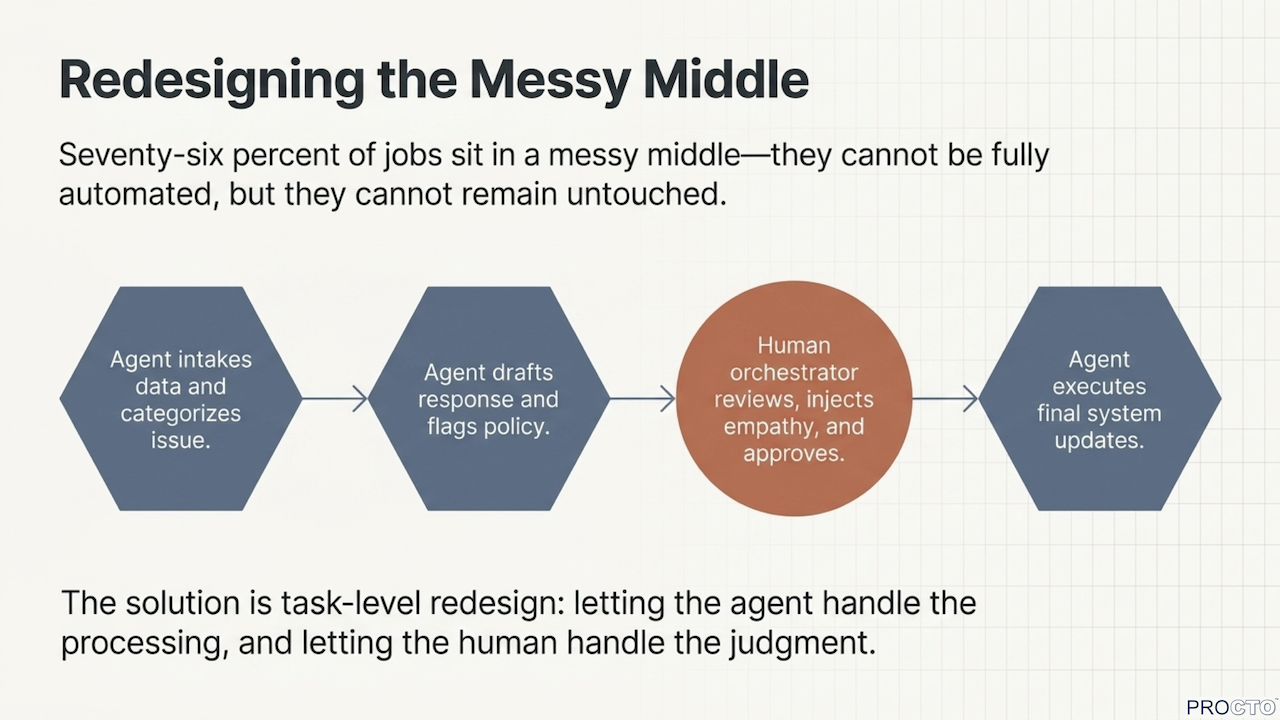
Most work already exists in a collaborative “messy middle.”
Managers review information.
Recruiters evaluate candidates.
Employees prepare work that others approve.
Rather than automating entire jobs, organizations should redesign individual tasks so that:
- AI handles repetitive execution.
- Humans focus on judgment, coaching, relationships, and decision-making.
This represents organizational design—not simply automation.
Why SMEs May Have an Advantage
Many assume AI will primarily benefit large enterprises.
Thomas suggested the opposite may often be true.
Small and medium-sized businesses typically have:
- Fewer approval layers
- Less bureaucracy
- Faster decision-making
- Greater organizational agility
That allows SMEs to experiment, redesign workflows, and adopt AI more quickly than many larger organizations burdened by legacy structures.
In the age of AI, agility may matter more than size.
Three Practical Steps for HR Leaders
For organizations wondering where to begin, Thomas shared three practical recommendations.
1. Start with a Workflow, Not an AI Tool
Instead of asking:
Which AI platform should we buy?
Ask:
Which workflow would benefit from an additional digital worker?
2. Define the Role Before Deploying AI
Clarify:
- Responsibilities
- Decision boundaries
- Escalation rules
- Success metrics
3. Assign Clear Ownership
Every AI-enabled workflow should have a human owner responsible for oversight, governance, and continuous improvement.
The Future Is Orchestrated
The future won’t be defined by AI alone. It will be defined by how effectively humans and AI work together.
Technology will continue to evolve.
AI Agents will become increasingly capable.
But organizations that succeed will not simply have better technology.
They will have better workforce design.
That means:
- Clearer roles
- Stronger governance
- Thoughtful trust
- Leaders who understand how people and AI collaborate
In other words, the future isn’t automated—it is orchestrated.
Get Your Complimentary Handbook
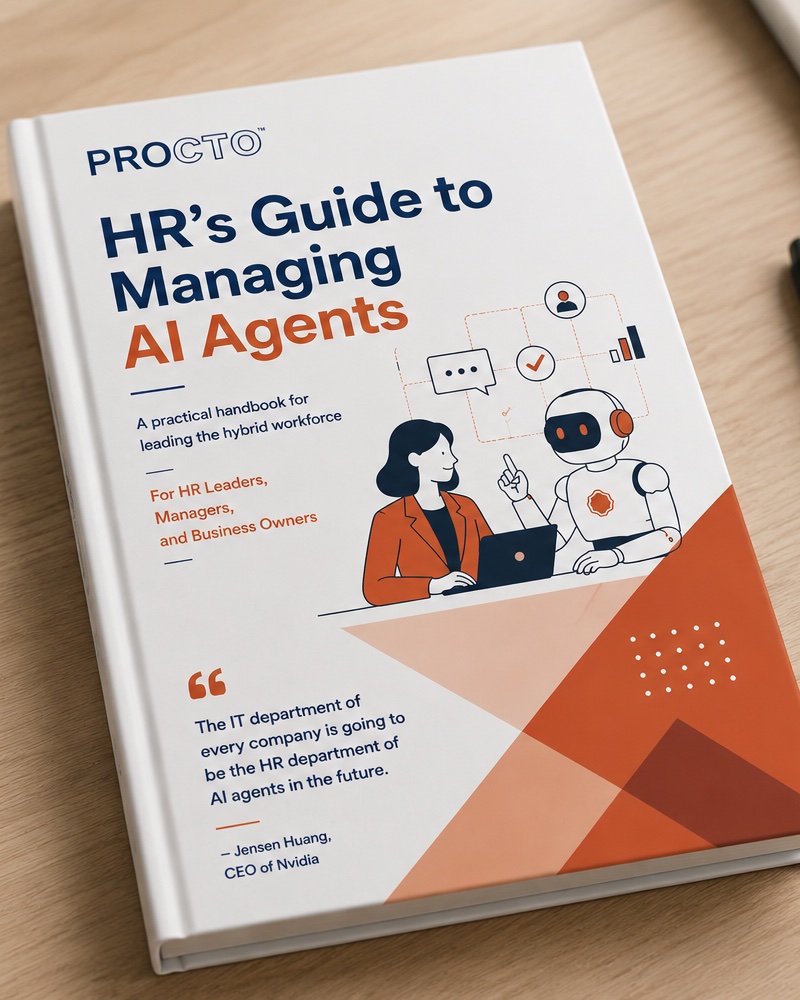
If these ideas resonate with you and you’d like to dive deeper, we’re offering a complimentary copy of our handbook:
HR’s Guide to Managing AI Agents
Written specifically for HR leaders, business owners, and managers, the handbook expands on the concepts covered during the HR Carnival session, including:
- Designing roles for AI Agents
- Onboarding digital workers
- Building trust and governance
- Managing human-AI collaboration
- Practical frameworks for HR-led AI adoption
Ready to prepare your organization for a future where humans and AI work side by side?
Click here to request your complimentary handbook.
Whether you’re just beginning your AI journey or looking to scale existing initiatives, we’d be delighted to continue the conversation and explore how HR can become a strategic driver of AI transformation.